
High-technology Enterprise、SRDI Enterprise
 current location:home > Process documents
重庆立道新材料科技有限公司 2025-01-06 15:32:32 阅览401
Author: Li Yangbin, Technical Department
Abstract
This paper describes the bath formula and process parameters of cyanide-free alkaline and cyanide-free acidic cadmium plating systems. It compares the two systems in terms of current efficiency, throwing power, covering power of the plating solution, as well as coating appearance, adhesion, corrosion resistance and hydrogen embrittlement resistance. The results show that the cyanide-free alkaline cadmium plating system outperforms the acidic counterpart in throwing power, covering power and coating appearance, making it more suitable as a replacement for traditional cyanide cadmium plating technology.
Keywords: Cyanide-free cadmium plating; Alkaline; Acidic; Plating bath and coating performance
Introduction
Electrodeposited cadmium coatings are generally silvery-white with compact structure, good softness and ductility. They can be treated with color passivation, army-green passivation and black passivation. Cadmium plating is mainly used as a protective coating for steel workpieces.
Under normal atmospheric and industrial atmospheric conditions, cadmium coating acts as a cathodic protective layer for steel substrates; while in humid or marine climates, it serves as a sacrificial anodic protective layer. The coating remains stable and discoloration-free in air at room temperature, and forms an oxide protective film in humid air to prevent further oxidation and corrosion.
Cadmium plating features good weldability and lubricity, low hydrogen embrittlement, high gloss, strong adhesion and excellent corrosion resistance, and is widely applied in aviation, marine and other industrial fields.
The mainstream cadmium plating technologies include cyanide cadmium plating, acidic cadmium plating and alkaline cadmium plating. Cyanide cadmium plating delivers excellent coating performance, but cyanide is highly toxic and prone to safety accidents during production. Currently, most industries adopt alkaline and acidic cyanide-free cadmium plating to replace cyanide processes.
Alkaline cadmium plating can achieve performance close to cyanide cadmium plating, yet its hydrogen embrittlement resistance for high-strength steel cannot fully meet the requirements of cyanide processes. Hence, cyanide cadmium plating is still adopted in special fields such as aeronautics and aerospace.
In 2012, Aviation Industry Corporation of China proposed replacing traditional cyanide cadmium plating with cyanide-free processes. However, substantial progress was hindered by severe hydrogen embrittlement problems when cyanide-free plating was applied to high-strength steel.
In April 2014, Chongqing Lida New Material Technology Co., Ltd. successfully developed the LD-5032 high-performance alkaline cadmium plating process. Its process stability and coating properties fully match those of cyanide cadmium plating, and its hydrogen embrittlement resistance passed a 216-hour high-strength assessment. Nearly nine years of practical production application has verified its outstanding comprehensive performance, making it one of the most mature and successful cyanide-free cadmium plating technologies at home and abroad.
一、Experimental Section
(一)Comparison of Bath Composition and Process Conditions of Cyanide-Free Alkaline and Acidic Cadmium Plating
1. Cyanide-Free Alkaline Cadmium Plating Process
Table 1 Bath Composition and Process Conditions of Cyanide-Free Alkaline Cadmium Plating
Control Item | Operating Range | Optimum Value |
Cadmium Sulfate | 30~45g/L | 40g/L |
Potassium Hydroxide | 50~70g/L(Initial Make-up) | 60g/L(Initial Make-up) |
90~110g/L(Total) | 100g/L(Total) | |
LD-5032Mu | 450~550mL/L | 500mL/L |
LD-5032A | 10~20 mL/L | 15mL/L |
LD-5032B | 10~20 mL/L | 12~14 mL/L |
LD-5032C | 5~10 mL/L | 8mL/L |
Temperature | 25~45℃ | 35~40℃ |
PH值 | ≥12 | 12以上 |
Cathode Current Density (Barrel Plating) | 0.5~2A/dm2 | 1A/dm2 |
Cathode Current Density (Rack Plating) | 0.5~4A/dm2 | 2A/dm2 |
2. Cyanide-Free Acidic Cadmium Plating Process
Table 2 Bath Composition and Process Conditions of Cyanide-Free Acidic Cadmium Plating
Control Item | Operating Range | Optimum Value |
Cadmium Sulfate | 40~50g/L | 44 g/L |
Ammonium Chloride | 180~220 g/L | 200 g/L |
Nitrilotriacetic Acid | 50~70 g/L | 60 g/L |
EDTA | 25~30 g/L | 28 g/L |
LD-5030A | 20~30mL/L | 25 mL/L |
LD-5030B | 5~8 mL/L | 7 mL/L |
LD-5030C | 5~8 mL/L | 7 mL/L |
PH Value | 6.2~6.7 | 6.5 |
Current Density | 0.6~2A/dm2 | 1 A/dm2 |
(二)Performance Comparison of Cyanide-Free Alkaline and Acidic Cadmium Plating Processe
1. Plating Bath Performance Comparison
(1)Cathode Current Efficiency
1、Test Method
The test was carried out in accordance with JB/T 7704.3 Test Methods for Electroplating Solutions – Part 3: Test of Cathode Current Efficiency. A copper coulometer was used to measure current efficiency.
Before testing, the cathode specimen B of the coulometer and cathode specimen A in the test plating bath were cleaned, dried and weighed accurately. Power was supplied according to process parameters. After electroplating, specimens A and B were taken out, cleaned, dried and weighed again. The weight gain of each specimen was calculated.
Cathode current efficiency is calculated by the following formula:
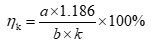
Where:
ηk —Cathode current efficiency of the tested solution (%);
a —Actual weight gain of cathode specimen A in the test bath (g);
b —Actual weight gain of cathode specimen B of the copper coulometer (g);
k—Electrochemical equivalent of precipitated substance on cathode (Cd: 2.097 g/A•h).
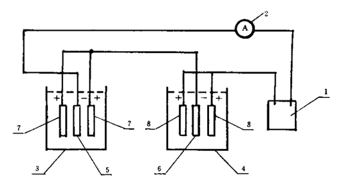
Figure 1 Schematic Diagram of Electroplating Current Efficiency Measured by Coulometer
(1-DC power supply;2-Ammeter;3、Test plating bath tank;4、Copper coulometer;5、Cathode of test plating bath;6-Cathode of copper coulometer;7、Anode of test plating bath;8、Anode of copper coulometer)
2、Test Records and Results
LD cyanide-free alkaline and acidic cadmium plating working solutions were prepared. Red copper sheets were used as test specimens. Test conditions: alkaline bath at 35℃, acidic bath at room temperature, current density 1 A/dm², plating time 30 min. Specimen weight was recorded before and after plating.
Table 3 Test Data of Plating Bath Current Efficiency
Current Density | Copper Coulometer Specimen Weight m0(g) | Test Specimen Weight m1 (g) | Current Efficiencyηk=a/b×100% | |||||
Before | After | Weight Gain a | Before | After | Weight Gain b | |||
Cyanide-free Alkaline Cd Plating | 1A/dm2 | 5.7348 | 6.3238 | 0.5890 | 5.6381 | 6.2638 | 0.6257 | 60.31% |
Cyanide-free Acidic Cd Plating | 1A/dm2 | 5.7632 | 6.3550 | 0.5918 | 5.7661 | 6.7503 | 0.9842 | 94.14% |
It is observed that the cyanide-free acidic cadmium plating bath has high cathode current efficiency above 90% at 1 A/dm², while the alkaline counterpart has a lower efficiency of about 60%.
(2)Throwing Power
1、Test Method
The throwing power of the plating solution was tested in accordance with JB/T 7704.4 Test Methods for Electroplating Solutions — Throwing Power Test[6]. The appropriate Hull cell (trapezoidal cell) panel method was adopted for the experiment, and the test positions on the specimen are shown in Figure 2.The coating thickness values δ₁, δ₂ … δ₈ at the middle of Regions 1 to 8 on the Hull cell panel were measured, where δ₁ refers to the position 1 cm in the high-current area and δ₈ to the position 1 cm in the low-current area. The throwing power was calculated according to the following formula:
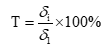
Where:
δi Coating thickness of any selected grid from No.2 to No.8;
δ1 Coating thickness of No.1 grid.
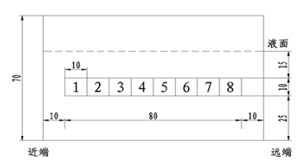
Figure 2 Schematic Diagram of Test Positions on the Specimen Panel
2、Test Records and Results
In this experiment, carbon steel sheets were used as test specimens in a 265 mL Hull cell test. The working solutions adopted were cyanide-free alkaline cadmium plating bath and cyanide-free acidic cadmium plating bath. The plating conditions were set as follows: temperature of the alkaline bath at 35 ℃, acidic bath at room temperature, current density of 1 A/dm², and plating time of 10 min. The coating thickness at the midpoint of each zone 1 to 8 on the Hull cell panel was recorded, and the test data and results are listed in Table 4 below.
Table 4 Throwing Power Test Data (Coating Thickness: μm)
Current | Time | δ1 | δ2 | δ3 | δ4 | δ5 | δ6 | δ7 | δ8 | δ8/δ1 | |
Cyanide-free Alkaline Cd Plating | 1.0A | 10min | 4.75 | 4.38 | 4.06 | 3.64 | 3.31 | 2.86 | 2.49 | 2.02 | 42.52% |
Cyanide-free Acidic Cd Plating | 1.0A | 10min | 6.18 | 5.32 | 4.51 | 3.84 | 3.14 | 2.42 | 1.51 | 0.81 | 13.66% |
(2)Covering Power
1、Test Method
Covering power was tested by the inner hole method in accordance with JB/T 7704.2 Test Methods for Electroplating Solutions – Part 2: Test of Covering Power.
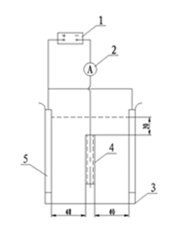
1-Power supply;2-Ammeter;3-Plating tank;4-Cathode;5-Anode
Figure 3 Schematic Principle of Plating Solution Covering Power Test2、Test Records and Results
Test conditions: current density 1.0 A/dm², plating time 30 min, alkaline bath 35℃, acidic bath room temperature. After plating, specimens were cut longitudinally to observe the plated length of inner holes. Covering power is evaluated by the ratio of plating depth to inner hole diameter; the higher the ratio, the better the covering power.
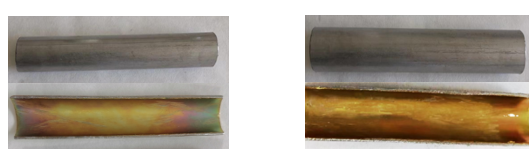
Cyanide-free Alkaline Cadmium Platin Cyanide-free Acidic Cadmium Plating
Figure 4 Test Results of Covering Power of Plating Solutions
The inner surface of the alkaline cadmium plating specimen was fully covered with cadmium coating with uniform color after passivation, achieving 100% covering power. The acidic specimen showed slow and uneven coloration with rough coating. Overall, the cyanide-free alkaline process has superior covering power.
(3)Coating Performance Comparison
1. Coating Appearance
Carbon steel sheets (100×50×1 mm) were plated under the same parameters: current density 1 A/dm², alkaline bath 35℃, acidic bath room temperature, plating time 40 min, followed by air drying and color passivation.
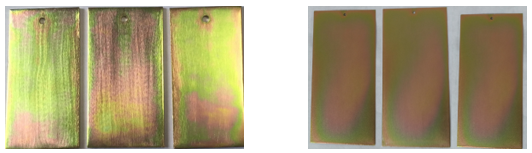
Cyanide-free Alkaline Cadmium Plating Specimen Cyanide-free Acidic Cadmium Plating Specimen
Figure 5 Appearance of Color Passivated Cadmium Coatings Obtained by Cadmium Plating Processes
The alkaline cadmium plating coating features fine and uniform crystalline structure with an even beige-gray color, bright silvery-white after brightening, and vivid iridescent color after passivation. The acidic coating has lower gloss; after brightening and passivation, its appearance is comparable to the alkaline one.
2. Coating Adhesion
1、Test Method
Bending Method: Plated panels with coating thickness of 11.27 μm (alkaline) and 10.73 μm (acidic) were bent repeatedly at 180° to observe peeling or delamination at the bending position.
Thermal Shock Method: Plated panels were kept in a constant temperature oven at 200℃ for 2 h, then immediately quenched in ice water at 0℃ to check blistering, stratification or peeling.
2、Test Result
Bending test: After repeated 180° bending of the test panels plated by cyanide-free alkaline and acidic cadmium plating processes, no peeling or flaking of the coating occurred at the bending positions, indicating that the coating adhesion of the two processes is equivalent.
Thermal shock test: No blistering, delamination or peeling was observed on the specimens of both cyanide-free alkaline and acidic cadmium plating, which demonstrates that the two processes deliver comparable coating adhesion performance.
(4)Corrosion Resistance
1、Test Method
Carbon steel sheets with dimensions of 100×50×1 mm were used as test specimens and electroplated respectively in cyanide-free alkaline cadmium plating bath and cyanide-free acidic cadmium plating bath.Plating parameters:Current density: 1 A/dm²;Temperature: 35 ℃ for alkaline cadmium plating, room temperature for acidic cadmium plating;Plating time: 60 min for alkaline cadmium plating, 40 min for acidic cadmium plating.Coating thickness of cyanide-free alkaline cadmium plating: 11.98 μm, 11.25 μm, 11.49 μm;Coating thickness of cyanide-free acidic cadmium plating: 11.88 μm, 11.12 μm, 11.98 μm.After color passivation, the specimens were subjected to NSS neutral salt spray test to evaluate corrosion resistance. The surface was observed for white corrosion products after 72 hours of testing, and for red corrosion products after 360 hours of testing[8].
2、Test Records and Results
The test records and results are shown in Table 5.
Table 5 Surface Condition of Coatings after NSS Neutral Salt Spray Test
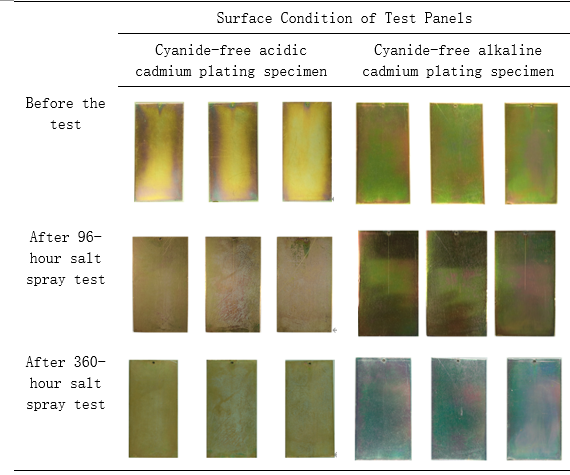 It can be seen from Table 5 that the cyanide-free alkaline cadmium plating specimens present uniform and fine surface color. After 96 hours of salt spray test, there is no obvious change in appearance except a slight fading of the passivation film, and no white corrosion products are generated. After 360 hours, the color of the passivation film fades further, the specimen surface becomes rough, and slight white rust appears in partial areas without any red corrosion products, showing qualified salt spray resistance.
The surface of cyanide-free acidic cadmium plating specimens is inherently rough, and becomes even rougher after the salt spray test. Slight white rust occurs in some areas while no red corrosion products appear, and its salt spray resistance also meets the qualification requirements.
(5)Hydrogen Embrittlement Susceptibility
1、Test Method
The hydrogen embrittlement test was carried out in accordance with HB 5067.1–2005, Hydrogen Embrittlement Test for Plating Processes — Part 1: Mechanical Method[9].Test bars made of 30CrMnSiA steel were adopted for cyanide-free alkaline and acidic cadmium plating.
Plating parameters: current density 1 A/dm²;Alkaline cadmium plating: temperature 35 ℃, plating time 60 min;Acidic cadmium plating: room temperature, plating time 40 min.Coating thickness of alkaline cadmium plating:12.85 μm, 12.59 μm, 12.64 μm, 12.58 μm, 12.39 μm, 12.49 μm;Coating thickness of acidic cadmium plating:12.25 μm, 12.39 μm, 12.14 μm, 12.18 μm, 12.19 μm, 12.29 μm.All specimens were subjected to hydrogen relief treatment at 200 ℃ for 24 h, followed by a 200-hour hydrogen embrittlement tensile test.
2、Test Records and Results
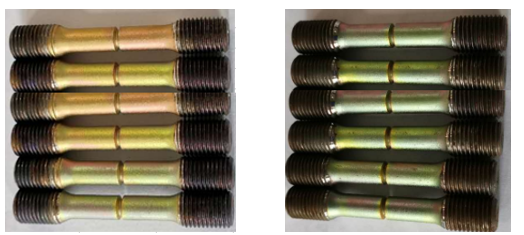
Cyanide-free alkaline cadmium plating Cyanide-free acidic cadmium plating
Figure 6 Coatings on 30CrMnSiA Test Bars
Using the above method, the hydrogen embrittlement resistance of coatings prepared by cyanide-free alkaline and acidic cadmium plating processes was tested on 30CrMnSiA steel bars. After hydrogen removal treatment, the specimens of both processes underwent a 200-hour hydrogen embrittlement tensile test. None of the specimens fractured within 200 hours, indicating that both processes exhibit qualified and equivalent hydrogen embrittlement resistance.
二、Conclusions
(一)Performance Comparison of Plating Bath and Coating
Table 6 Performance Comparison of Cyanide-Free Alkaline and Acidic Cadmium Plating Processes
Category | Cyanide-Free Alkaline Cadmium Plating | Cyanide-Free Acidic Cadmium Plating | |
Coating Performance | Appearance | Fine uniform beige-gray crystal; bright silvery-white after brightening; vivid iridescent passivation film | Rough crystal; uneven beige-yellow / beige-gray |
Adhesion | Excellent | Good | |
Corrosion Resistance | Excellent (no white rust at 96 h; no red rust at 360 h) | Good (no white rust at 96 h; no red rust at 360 h) | |
Bath Performance | Bright Current Range | Wide | Wide |
Current Efficiency | ≥60% | ≥90% | |
Throwing Power | ≥40% | ≥10% | |
Covering Power | 100% (fast coloration, fine and bright) | 100% (slow coloration, rough and dim) | |
(二)Summary of Cadmium Plating Process Comparison
(1)The cyanide-free alkaline cadmium plating process features fine and uniform coating appearance, cathode current efficiency over 60%, throwing power above 40% (far superior to acidic process) and excellent covering power.
(2)The cyanide-free acidic cadmium plating has high current efficiency but poor throwing power and inferior covering power and coating appearance.
Comprehensive performance verification proves that the cyanide-free alkaline cadmium plating process is more suitable to replace traditional cyanide cadmium plating technology.
References
[1] Zhang Baocheng. Electroplating Technology [M]. Beijing: Beihang University Press, 1993:76-77.
[2] Liu Qiang, Lin Naiming, Sha Chunpeng, et al. Research Status of Cadmium Electroplating on Steel Materials[J]. Surface Technology, 2017,46(01):146-157.
[3] Li Bo. Study on Cyanide-Free Cadmium Plating as a Substitute for Cyanide Process[J]. Electroplating & Finishing, 2016,38(04):32-35.
[4] Li Yanze, Li Yungang, Ren Xiqiang, et al. Research Status on Hydrogen Embrittlement Damage of High-Strength Steel for Automobile[J/OL]. Shanghai Metals:1-10.
[5] JB/T 7704.3, Test Methods for Electroplating Solutions: Cathode Current Efficiency Test.
[6] JB/T 7704.4, Test Methods for Electroplating Solutions: Throwing Power Test.
[7] JB/T 7704.2, Test Methods for Electroplating Solutions: Covering Power Test.
[8] Chen Xinxin, Fu Yiping, Liu Xiuzhen, et al. Study on Salt Spray Test of Zinc Plating Process[J]. Environmental Technology, 2021(S1):33-36.
[9] HB 5067.1–2005, Hydrogen Embrittlement Test for Plating Processes – Part 1: Mechanical Method.

