
High-technology Enterprise、SRDI Enterprise
 current location:home > Process documents
重庆立道新材料科技有限公司 2026-06-02 14:43:41 阅览104
By Li Li, Mo Xinlu;Technical Department
Abstract
Composite materials reinforced with glass fiber, carbon fiber, silicon carbide fiber and other fillers in engineering plastics exhibit excellent overall performance and are widely used in aerospace, military equipment, electronics, electrical engineering, automotive, construction, office equipment, machinery and other industries. In practical applications, such composite materials usually require surface metallization to meet various functional requirements. Based on production practice, this paper details the metallization process flow for composite materials, which is highly suitable for the metallization of PPS, LCP, PEI and other composite materials.
Keywords: composite materials; metallization; electroplating; electroless plating
1. Preface
Materials are the foundation of scientific and technological development. As a rapidly developing category of new materials, composite materials have greatly promoted the progress of science and technology, especially in the aerospace industry.
Composite materials are composed of two or more materials with different properties through physical or chemical methods to form a new macroscopic material with synergistic properties. The components complement each other, resulting in superior comprehensive performance over individual raw materials to meet diverse application requirements.
Engineering plastics themselves feature outstanding mechanical properties, durability, corrosion resistance and heat resistance, with easier processing and the ability to replace metal materials. By adding glass fiber, carbon fiber, silicon carbide fiber and other reinforcements, the strength and performance of engineering plastics are further enhanced. Such composites are widely used in aerospace, electronics, electrical engineering, automotive, construction, office equipment and machinery.
In practical applications, surface metallization is often required to achieve specific functions. Based on industrial practice, this paper introduces a stable metallization process suitable for PPS, LCP, PEI and other composite materials.
2. Process Flow
Sandblasting → High-temperature baking → Ultrasonic cleaning → Swelling → Roughening → Neutralization → Special activation → Surface conditioning → Colloidal palladium activation → Degelation → Alkaline electroless nickel plating → Subsequent processes
3. Process Description
3.1 Sandblasting
Sandblasting is used to roughen the composite surface; without it, coating adhesion cannot be guaranteed.
Abrasive: artificial corundum, 160–200 mesh
Operation: uniformly blast all surfaces of the part to ensure full coverage.
3.2 High-temperature Baking
Sandblasted parts are placed in metal trays and baked at 200 ℃ for about 6 hours to relieve surface stress and prevent poor coating adhesion caused by residual stress.
3.3 Ultrasonic Cleaning
Removes residual abrasive particles and surface contaminants after sandblasting.
Parameter | |
LD-5730 Total alkalinity Temperature Time | 20~50g/L 25~60point 50~60℃ 5~15min |
3.4 Swelling
Swelling softens and loosens the polymer, reduces interchain bonding energy, and facilitates subsequent etching by permanganate. The swelling agent penetrates the polymer network and replaces weak secondary bonds, creating a micro-roughened surface to improve coating adhesion.
LD-5732 Special Material Swelling Agent functions:
(1)Reduces surface tension and improves hydrophilicity.
(2)Swells the substrate for easier permanganate etching.
Parameter | |
LD-5732swelling agent Potassium hydroxide Temperature Time | 80~120ml/L 380~400g/L 75~85℃ 15~25min |
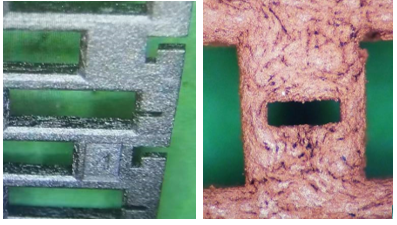
Different composite materials require different swelling durations, and the optimal swelling time should be determined according to the specific material. Insufficient swelling may result in poor coating adhesion, while excessive swelling will deteriorate the surface condition of parts and may even reduce their strength.The figures below show poor adhesion caused by insufficient swelling and part corrosion caused by excessive swelling, respectively.
Insufficient Swelling Excessive Swelling
3.5 Roughening
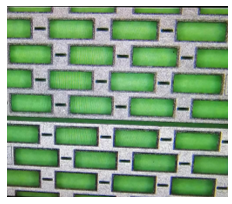
Uses the strong oxidizing property of KMnO₄ under high temperature and strong alkaline conditions to decompose the polymer.:
4MnO4-+C(polymer)+4OH-→4MnO42-+CO2(g)+H2O
Side reactions:4MnO4-+4OH-=4MnO42-+O2(g)+2H2O
MnO₄²⁻ also undergoes the following side reaction in alkaline medium:MnO42-+2H2O+2e-=MnO2(s)+4OH-
An electrolytic regeneration unit can oxidize manganate back to permanganate.
Appearance of parts with different roughening times
The process parameters are shown in the table below:
Component | Parameter |
LD-5735A LD-5735B Temperature Time | 100~150g/L 50~100g/L 75~85℃ 10~20min |
3.6 Neutralization
It is used to remove manganese dioxide, manganate and permanganate remaining on the substrate surface. Manganese ions are heavy metal ions, and their presence causes palladium poisoning, which deactivates palladium ions or atoms and leads to metallization failure. Therefore, manganese must be completely removed before palladium activation.
Generally, about 3% dilute sulfuric acid and about 3% hydrogen peroxide can be used to remove manganese compounds on the substrate surface. However, manganese compounds easily catalyze the decomposition of hydrogen peroxide, resulting in a short service life of the solution, which needs to be replaced every 1 to 2 weeks.
LD-5738 exhibits excellent reduction effect on high-valent manganese, effectively removing residual manganese on parts, while providing stable bath performance and long service life.
The specific process parameters are shown in the table below:
Component | Parameter |
LD-5738 Neutralizer Temperature Time | 45~55g/L Room 5~10min |
3.7 Special Activation
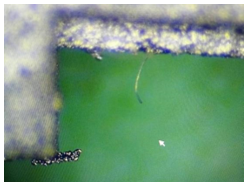
Composites often contain glass fiber, silicon carbide fiber and metal fillers. Exposed fillers cause coating burrs and poor continuity.
LD-5740 is a dedicated pretreatment agent that etches exposed inorganic fillers, ensures coating continuity and enhances adhesion.
The process parameters are shown in the table below:
Component | Parameter |
LD-5740 Special Activator Agitation Temperature Time | 60~80g/L Air agitation Room 5~10min |
3.8 Surface Conditioning
Uses cationic surfactants to reverse surface charge from negative to positive, improving adsorption of colloidal palladium, reducing surface tension and enhancing wetting.
The process parameters are shown in the table below:
Component | Parameter |
LD-5742 Surface Conditioner Agitation Temperature Time | 200~300ml/L Reciprocating 40~50℃ 3~5min |
The surface conditioner contains charge regulators and is sensitive to various impurities such as metal ions. Therefore, the bath should be kept clear during use. The quality of surface conditioning directly affects the adsorption of colloidal palladium activator.
3.9 Activation
Electroless nickel plating reduces Ni²⁺ to metallic Ni under the action of a reducing agent. Without a catalyst, the reduction efficiency is very low, and the resulting Ni atoms are difficult to deposit directionally. Activation forms a palladium catalytic film on the insulator surface, which not only accelerates the reduction rate of nickel ions but also promotes the directional deposition of nickel.
Since the activator is a type of palladium with high charge density, it is highly sensitive to most metal ions, especially copper, iron, and nickel ions. Severe contamination may even cause precipitation. Therefore, in routine production, the contents of copper and iron in the bath should be regularly monitored: copper ions < 1000 ppm, iron ions < 200 ppm. If coagulation or precipitation occurs in the bath, the entire bath must be replaced; adding more concentrated activator will not help. Partial replacement to save cost is not recommended, as product quality cannot be guaranteed.
To protect the activation bath, avoid excessive water and impurity introduction, and maintain the stability of the palladium bath, pre-dipping treatment is required before palladium activation.
The pre-dipping process parameters are shown in the table below:
Component | Parameter |
LD-5745B salt Specific gravity Temperature Time | 250~300g/L 1.12~1.16 Room temperature 1~3min |
The activation process parameters are shown in the table below:
Component | Parameter |
LD-5745A Palladium LD-5745B salt Stannous chloride Specific gravity Temperature Time | 5~20ml/L 250~300g/L 3~5 g/L 1.12~1.16 25~38℃ 3~8min |
3.10 Degelation
The palladium colloid adsorbed on the substrate surface takes palladium atoms as the core and is surrounded by stannous ions. Water rinsing after activation causes hydrolysis of stannous ions into colloidal substances that encapsulate the palladium atoms, resulting in insufficient catalytic activity. Therefore, a degelation treatment is required.
LD-5750 can remove tin with high selectivity and effectively restore the catalytic activity of palladium. The working solution is highly stable and thus features a long service life. Other advantages include ease of use, single-component formulation, compatibility with automatic production lines, effective removal of colloidal tin, and good filterability.
Parameter | |
LD-5750 Temperature Time | 40~60g/L 45~55℃ 4~8min |
3.11 Electroless Nickel Plating
After palladium activation, the composite surface is fully covered with a layer of palladium catalytic particles, and then electroless nickel pre-plating can be carried out. The process parameters are shown in the table below:
Component | Parameter |
LD-5420A LD-5420B LD-5420C Ph Temperature Time | 40~50g/L 40~50g/L 40~50g/L 8.5~9.5 35~45℃ 4~8min |
3.12 Subsequent Electroplating
After electroless nickel plating, the non-conductive substrate becomes fully conductive. Subsequent electroless plating or electroplating can be performed as required.
4、Related Products
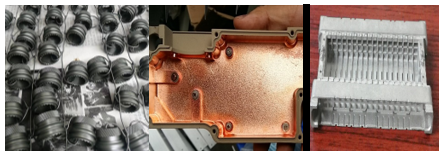
Cadmium plating on PEI composite Copper plating on PPS Nickel plating on LCP
5、Conclusion
Engineering plastic‑based composites feature excellent stability, heat resistance, chemical resistance, high strength and light weight, supporting rapidly growing demand across industries.
Different materials require tailored processes. The process described in this paper enables stable, large‑scale metallization of PEI, PPS, LCP and similar composite materials.
References
[1] Zhang Yuncheng, et al. Electroplating Manual (4th Edition)[M]. National Defense Industry Press.
[2] Jiang Xiaoxia, Shen Wei. Theory and Practice of Electroless Plating[M]. National Defense Industry Press.

